


8/270
\begin{frame}
  \frametitle{Usefulness of Semantics}

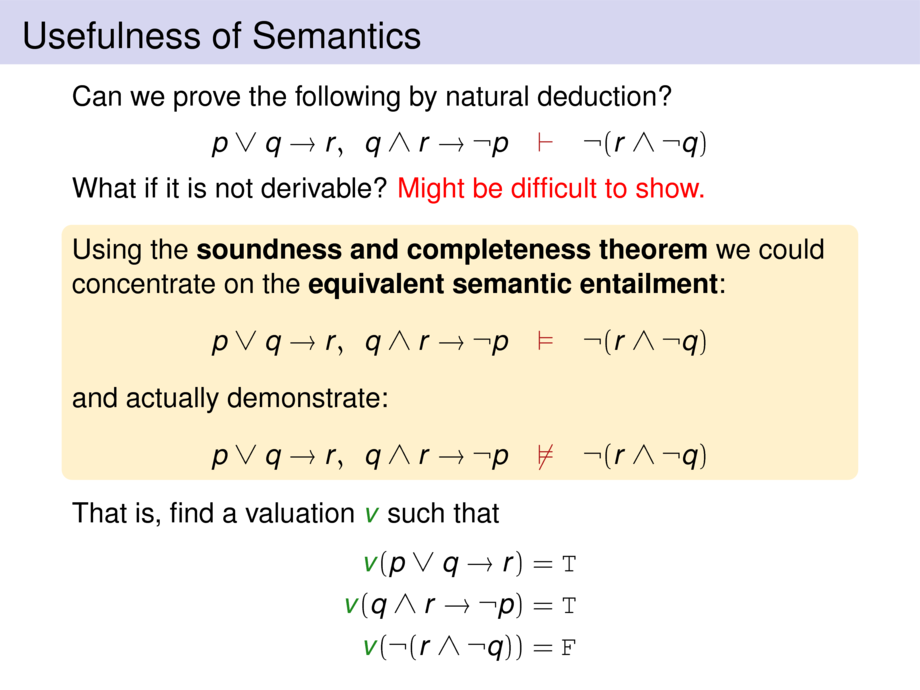
  Can we prove the following by natural deduction?
  \begin{center}
    $
    \formula{\logimp{\logor{\prop{p}}{\prop{q}}}{\prop{r}}}, \;\;
    \formula{\logimp{\logand{\prop{q}}{\prop{r}}}{\lognot{\prop{p}}}}
      \;\;\derives\;\;
    \formula{\lognot{(\logand{\prop{r}}{\lognot{\prop{q}})}}}
    $
  \end{center}\pause{}
  What if it is not derivable? \pause \alert{Might be difficult to show.}
  \pause\smallskip

  \begin{goal}{}
  Using the \emph{soundness and completeness theorem}
  we could concentrate on the \emph{equivalent semantic entailment}:
  \begin{center}
    $
    \formula{\logimp{\logor{\prop{p}}{\prop{q}}}{\prop{r}}}, \;\;
    \formula{\logimp{\logand{\prop{q}}{\prop{r}}}{\lognot{\prop{p}}}}
      \;\;\satisfies\;\;
    \formula{\lognot{(\logand{\prop{r}}{\lognot{\prop{q}})}}}
    $
  \end{center}\pause{}
  and actually demonstrate:
  \begin{center}
    $
    \logimp{\logor{\prop{p}}{\prop{q}}}{\prop{r}}, \;\;
    \logimp{\logand{\prop{q}}{\prop{r}}}{\lognot{\prop{p}}}
      \;\;\satisfiesnot\;\;
    \lognot{(\logand{\prop{r}}{\lognot{\prop{q}})}}
    $
  \end{center}
  \end{goal}
  \pause\smallskip

  That is, find a valuation $\saval$ such that
  \begin{align*}
    \aval{\formula{\logimp{\logor{\prop{p}}{\prop{q}}}{\prop{r}}}} & = \True
    \\
    \aval{\formula{\logimp{\logand{\prop{q}}{\prop{r}}}{\lognot{\prop{p}}}}} & = \True
    \\
    \aval{\formula{\lognot{(\logand{\prop{r}}{\lognot{\prop{q}})}}}} & = \False
  \end{align*}
\end{frame}