


64/77
\begin{frame}{Chomsky Normal Form}
  \begin{block}{}
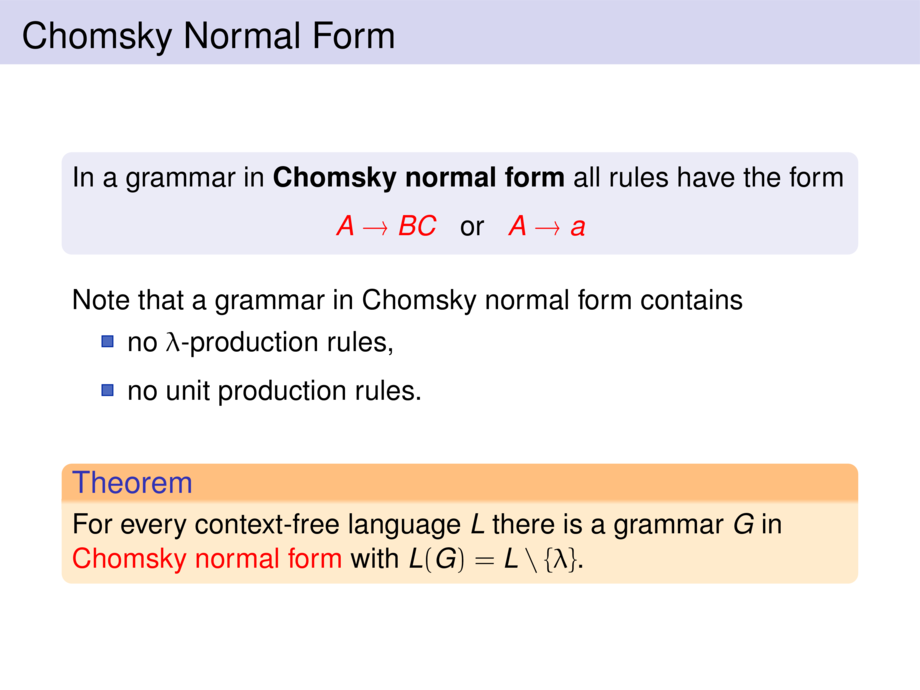
    In a grammar in \emph{Chomsky normal form} all rules have the form
    \begin{talign}
      \alert{A \to BC} \;\; \mbox{ or } \;\; \alert{A \to a}
    \end{talign}
  \end{block}
  \pause\medskip

  Note that a grammar in Chomsky normal form contains
  \begin{itemize}
    \item no $\lambda$-production rules,
    \item no unit production rules.
  \end{itemize}
  \pause\bigskip

  \begin{goal}{Theorem}
    For every context-free language $L$ there is a grammar $G$
    in \alert{Chomsky normal form} with $L(G) = L \setminus \{\lambda\}$.
  \end{goal}
\end{frame}