


6/38
\begin{frame}{Example}
  \begin{example}
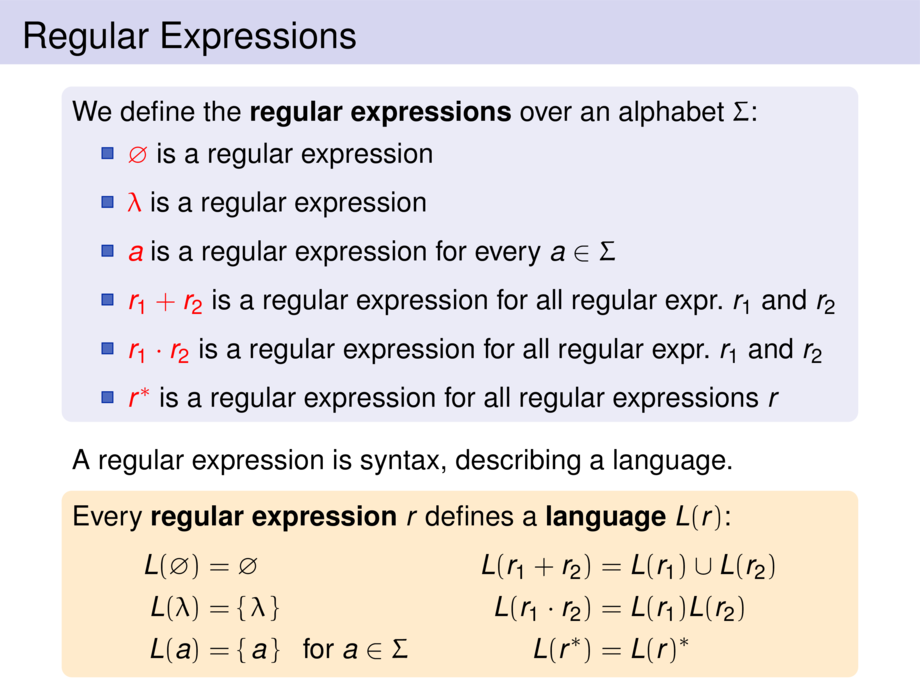
  $L((a+b) \cdot c^*) = (\{\,a\,\} \cup \{\,b\,\}) \{\,c\,\}^* = \{\,a,b\,\} \{\,c\,\}^*$
  \end{example}
  \pause\bigskip

  \begin{goal}{}
  Regular expressions are used to search and manipulate text.
  \end{goal}
  \medskip

  \begin{minipage}{.7\textwidth}
  For example:
  \begin{itemize}
    \item \texttt{grep} in Linux
    \item script languages such as Perl
  \end{itemize}
  \end{minipage}
  \begin{minipage}{.29\textwidth}
    \includegraphics[height=12mm]{images/regular-expressions.jpg}
  \end{minipage}
  \medskip

  Every major programming language has regular expressions.
  \pause\bigskip\medskip

  \begin{exampleblock}{Exercise}
    Find a regular expression $r$ over $\Sigma = \{\,a,b\,\}$ such that\\ $L(r)$
    consists of all words that contain the pattern \alert{$bab$}:
    \pause
    \begin{talign}
      (a+b)^* \cdot b\cdot a\cdot b \cdot (a+b)^* \mpause[1]{=
      (a+b)^* \; bab \; (a+b)^*}
    \end{talign}
  \end{exampleblock}
\end{frame}