


47/87
\begin{frame}
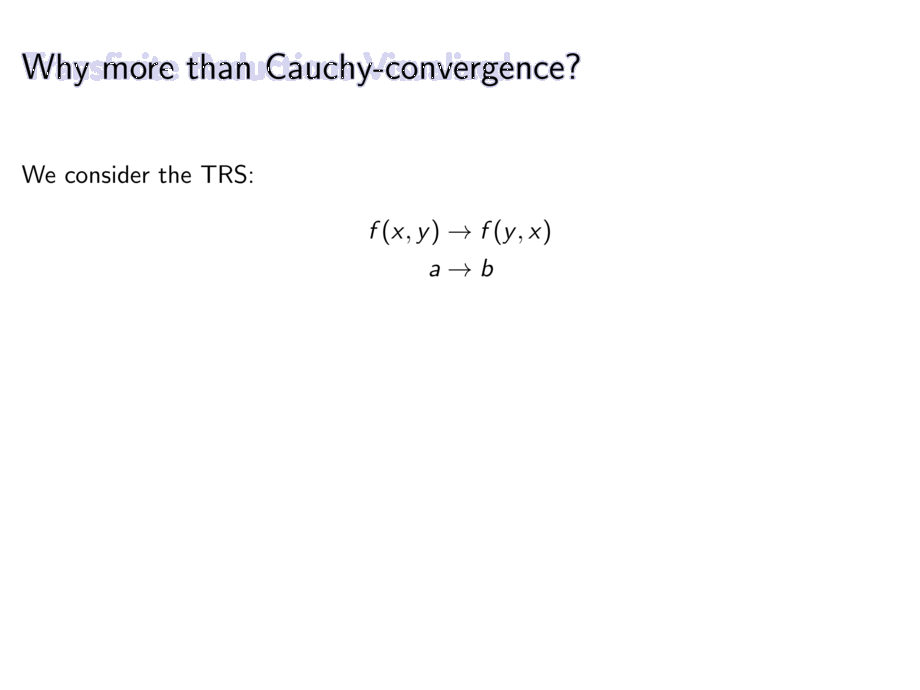
  \frametitle{Why more than Cauchy-convergence?}

  We consider the TRS:
  \begin{align*}
    f(x,y) &\to f(y,x)\\
    a &\to b
  \end{align*}
  \pause

  We start from $f(a,a)$ and trace the left occurrence of $a$:
  \pause
  \begin{align*}
    f(\overline{a},a) \to f(a,\overline{a}) \to f(\overline{a},a) \to f(a,\overline{a}) \to^\omega \alert{\ ?}
  \end{align*}
  \vspace{-2ex}

  The rewrite sequence without overlining is Cauchy-convergent.
  \medskip

  However, what are the residuals of the left $a$ after $\omega$-many steps?
  \pause\medskip

  Although it appears as if the term has a limit, this is only a syntactic accident.\\
  The subterms get swapped all the time\ldots
\end{frame}