



147/250
\begin{frame}
  \small

  \begin{example}
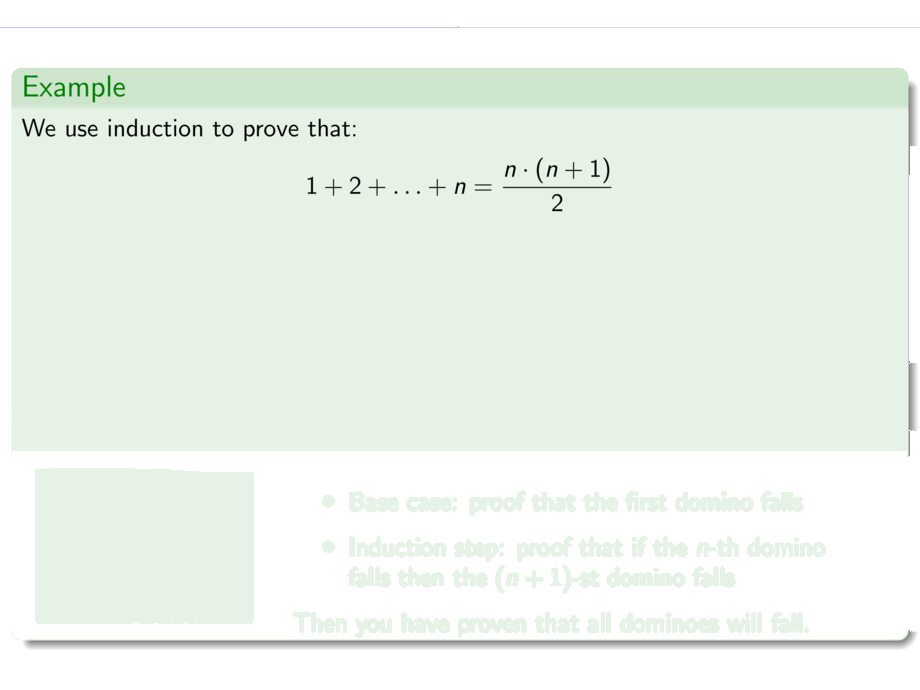
    We use induction to prove that:
    \vspace{-1ex}
    \begin{align*}
      1 + 2 + \ldots + n = \frac{n \cdot (n+1)}{2}
    \end{align*}
    \vspace{-5ex}

    \begin{enumerate}
      \item<2->
        Base case $n = 0$:
        \onslide<3->
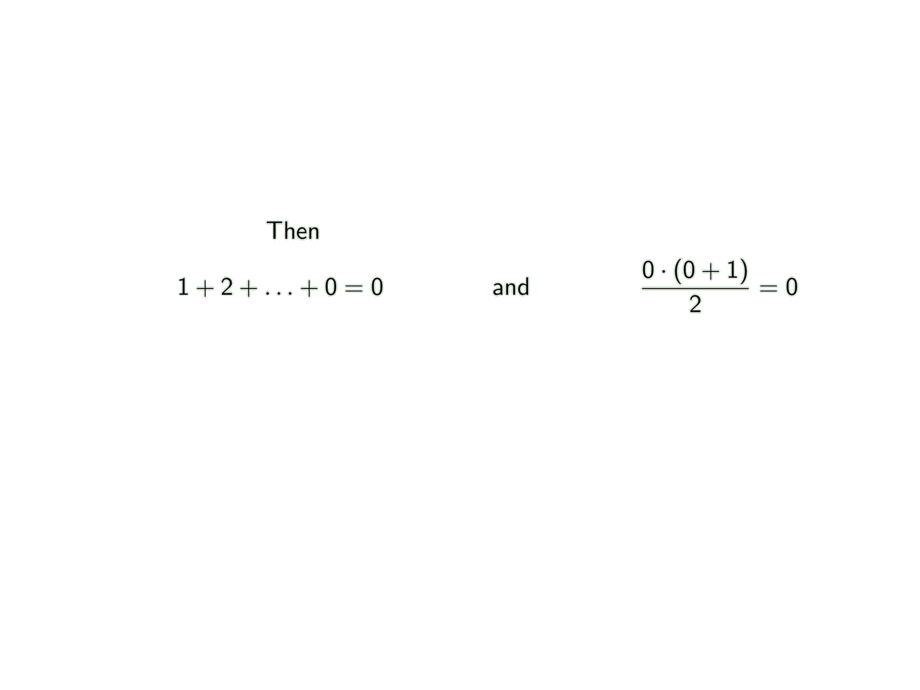
        Then
        \vspace{-1ex}
        \begin{align*}
          1 + 2 + \ldots + 0 &= 0 & \text{ and }&&  \frac{0 \cdot (0+1)}{2} &= 0
        \end{align*}
        \vspace{-2ex}
        \onslide<4->
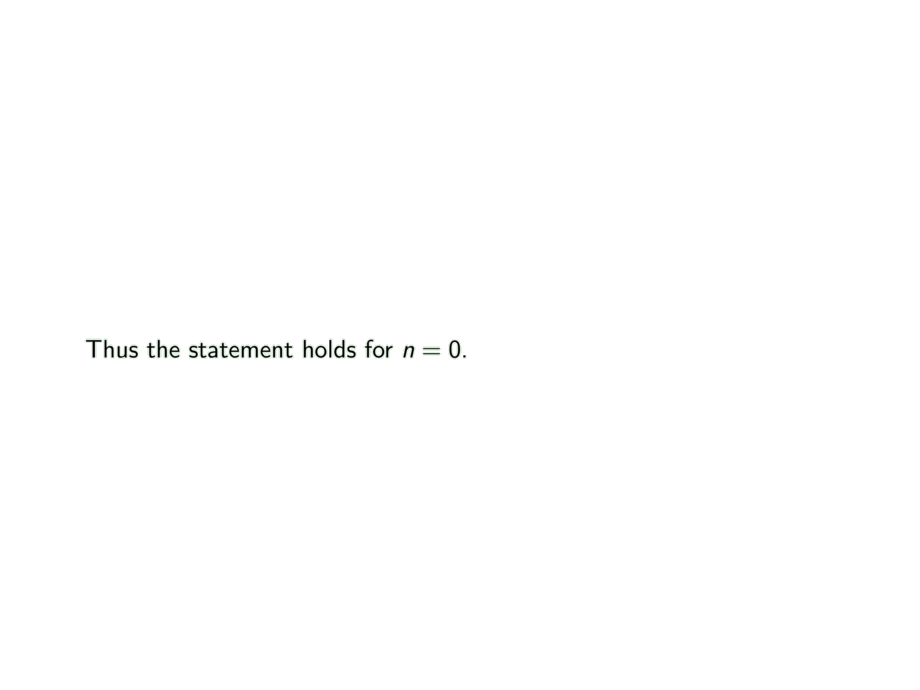
        Thus the statement holds for $n = 0$.
        \medskip
      \item<5->
        Induction step:\\
        \onslide<6->
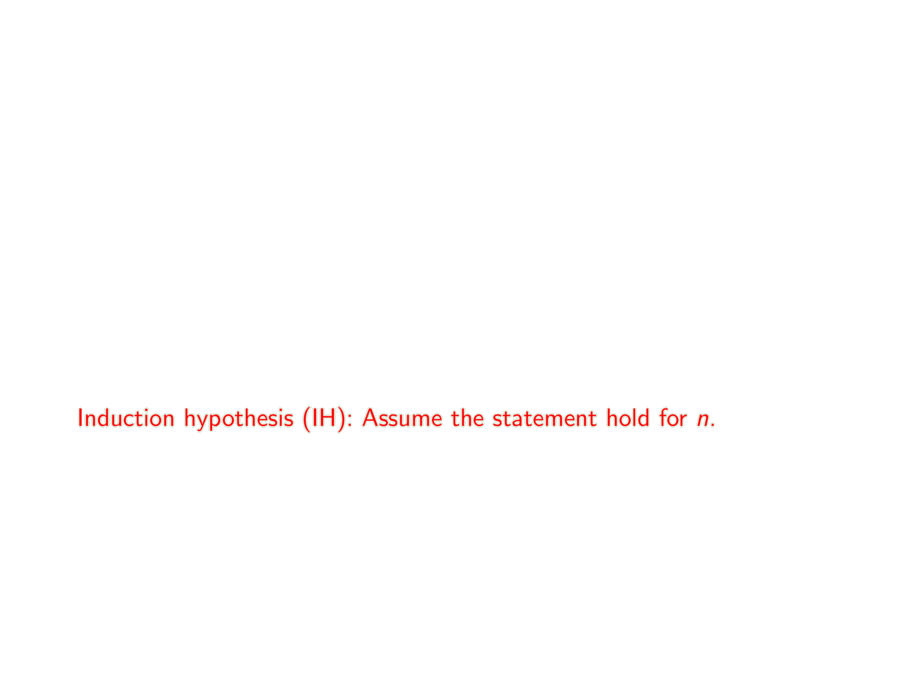
        \alert<6->{Induction hypothesis (IH): Assume the statement hold for $n$.}\\[1ex]
        \onslide<7->
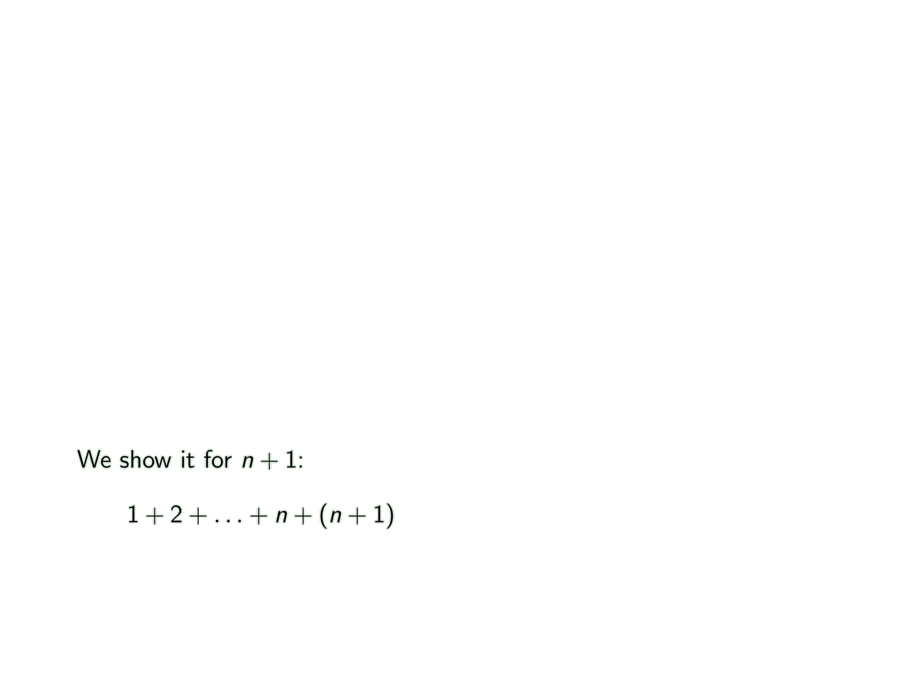
        We show it for $n+1$:
        \vspace{-1ex}
        \begin{align*}
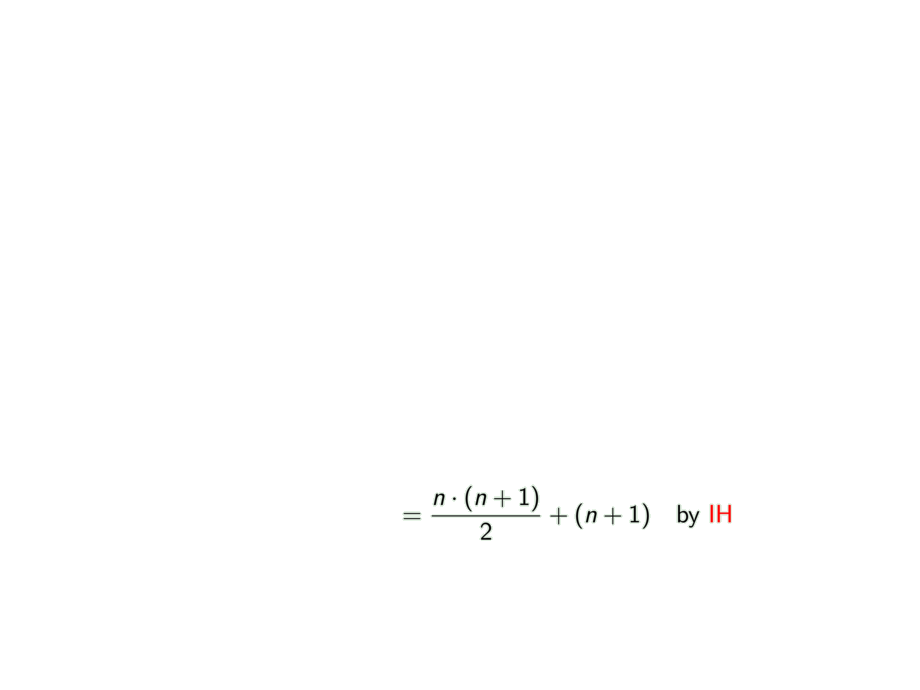
          1 + 2 + \ldots + n& + (n+1) \onslide<8->{= \frac{n \cdot (n+1)}{2} + (n+1) \quad \text{by \alert{IH}}}\\
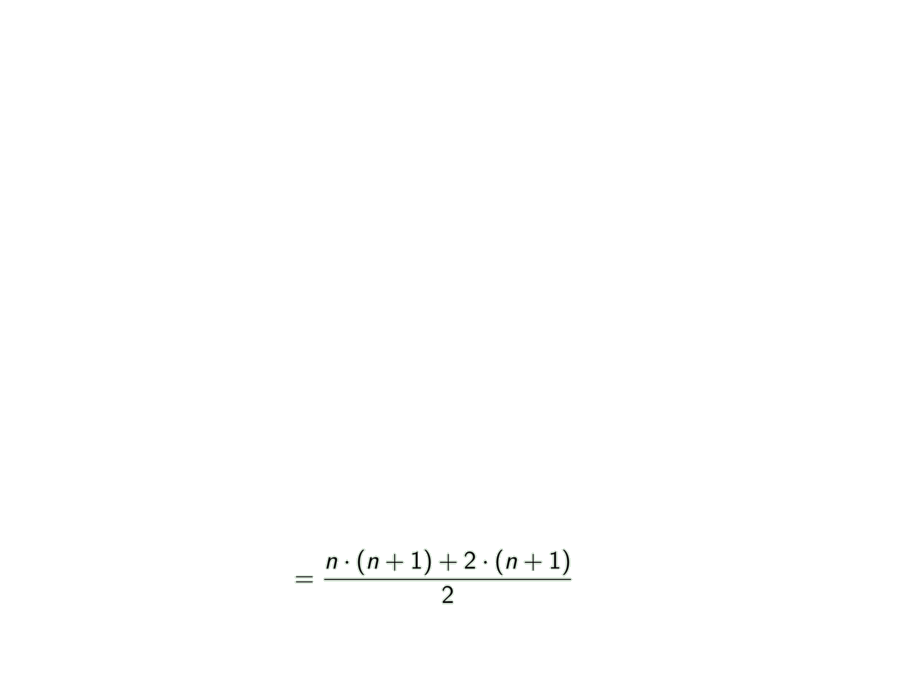
          &\onslide<9->{= \frac{n \cdot (n+1) + 2\cdot(n+1)}{2}}
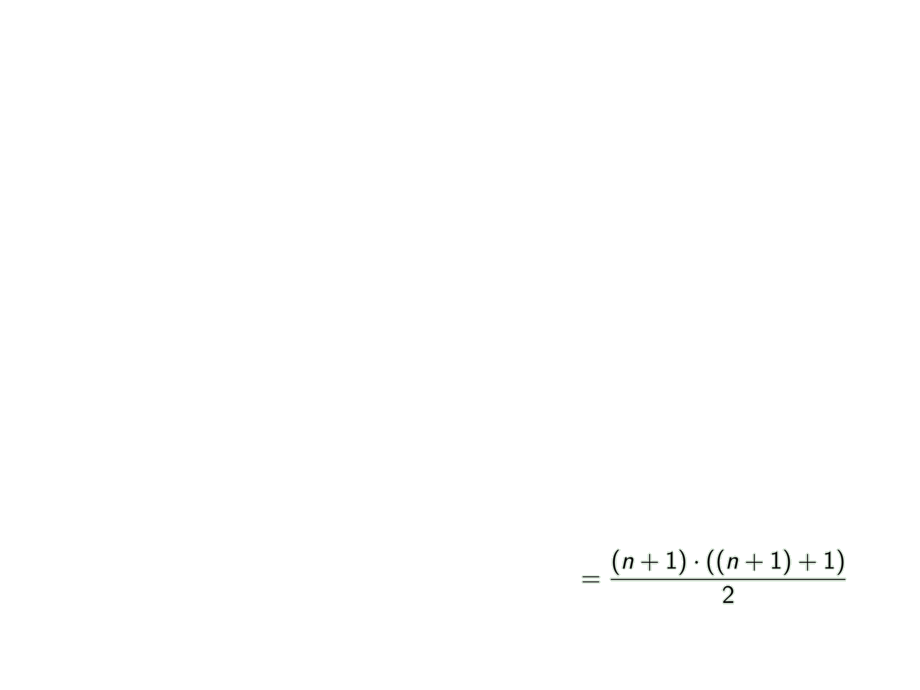
          \onslide<10->{= \frac{(n+1) \cdot ((n+1) + 1)}{2}}
        \end{align*}
        \vspace{-5ex}
    \end{enumerate}
    \onslide<11->
    Hence the formula holds for all $n \in \NN$.
  \end{example}
\end{frame}