


40/70
\begin{frame}
  \frametitle{Exercises}

  \begin{alertblock}{}
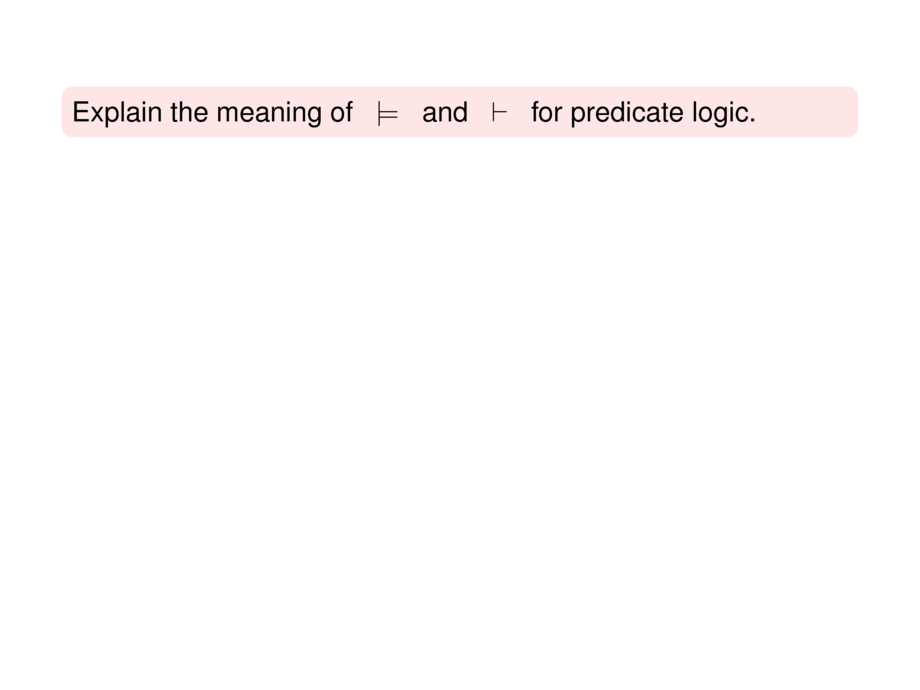
    Explain the meaning of \;\;$\models$\;\; and \;\;$\vdash$\;\; for predicate logic.
  \end{alertblock}
  \pause

  \begin{exampleblock}{}
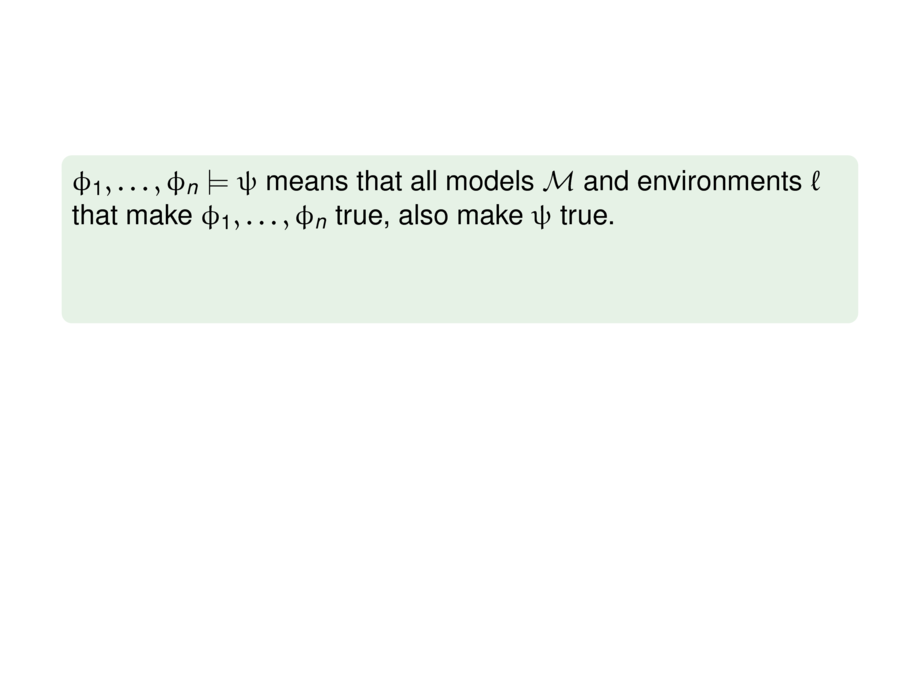
    $\phi_1,\ldots,\phi_n \models \psi$ means that all models $\mathcal{M}$ and environments $\ell$
    that make $\phi_1,\ldots,\phi_n$ true, also make $\psi$ true.
    \medskip
    \pause

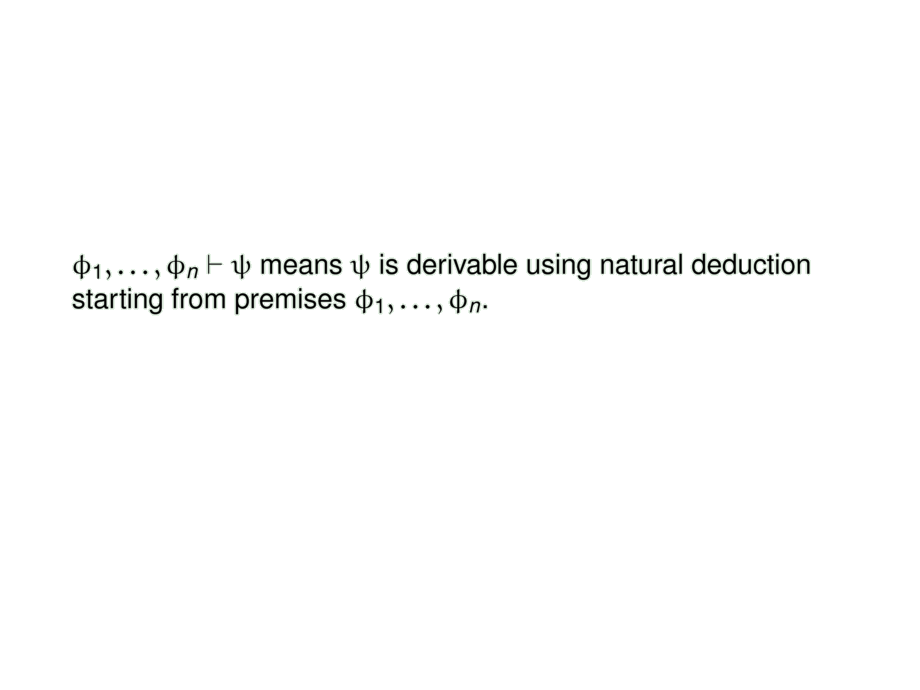
    $\phi_1,\ldots,\phi_n \vdash \psi$ means $\psi$ is derivable using natural deduction starting
    from premises $\phi_1,\ldots,\phi_n$.
  \end{exampleblock}
  \pause

  \begin{alertblock}{}
    Explain soundness/correctness and completeness.
  \end{alertblock}
  \pause

  \begin{exampleblock}{}
    Soundness means that everything derivable by natural deduction is also semantically entailed:
    \begin{talign}
      \Gamma \vdash \phi \;\implies\; \Gamma \models \phi
    \end{talign}
    \pause
    Completeness means that the derivation rules are strong enough to
    derive everything that is semantically entailed:
    \begin{talign}
      \Gamma \models \phi \;\implies\; \Gamma \vdash \phi
    \end{talign}
  \end{exampleblock}
\end{frame}