



95/116
\begin{frame}
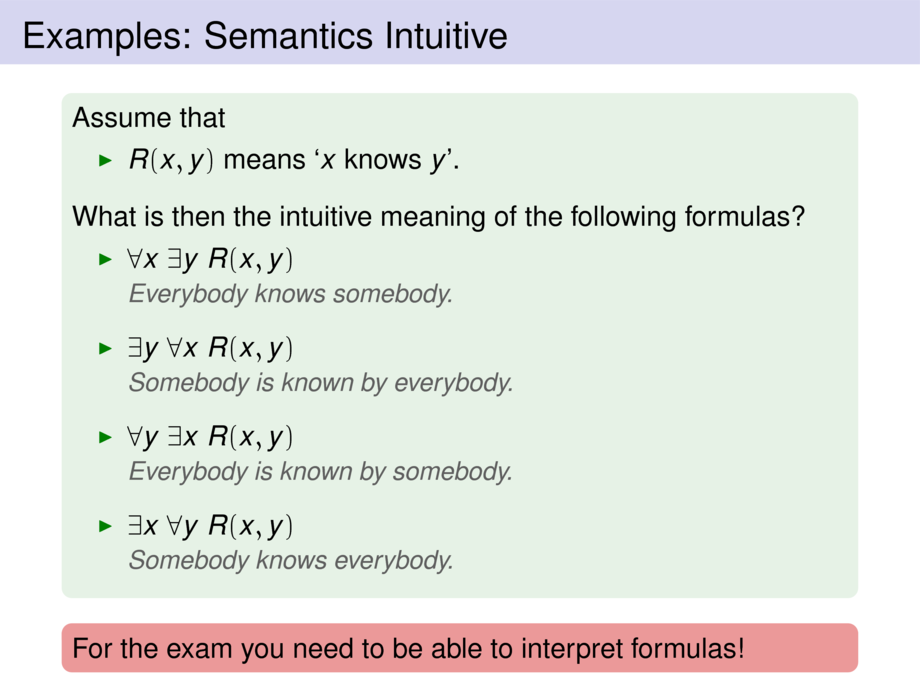
  \frametitle{Examples: Semantics Intuitive}

  \begin{alertgoal}{}
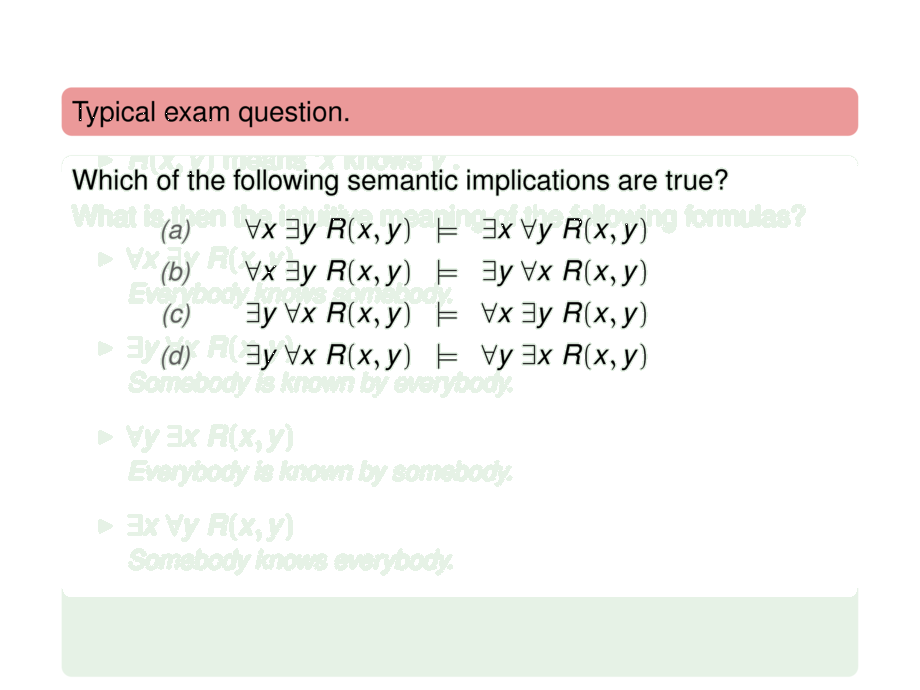
    Typical exam question.
  \end{alertgoal}

  \begin{exampleblock}{}
    Which of the following semantic implications are true?
    \begin{talign}
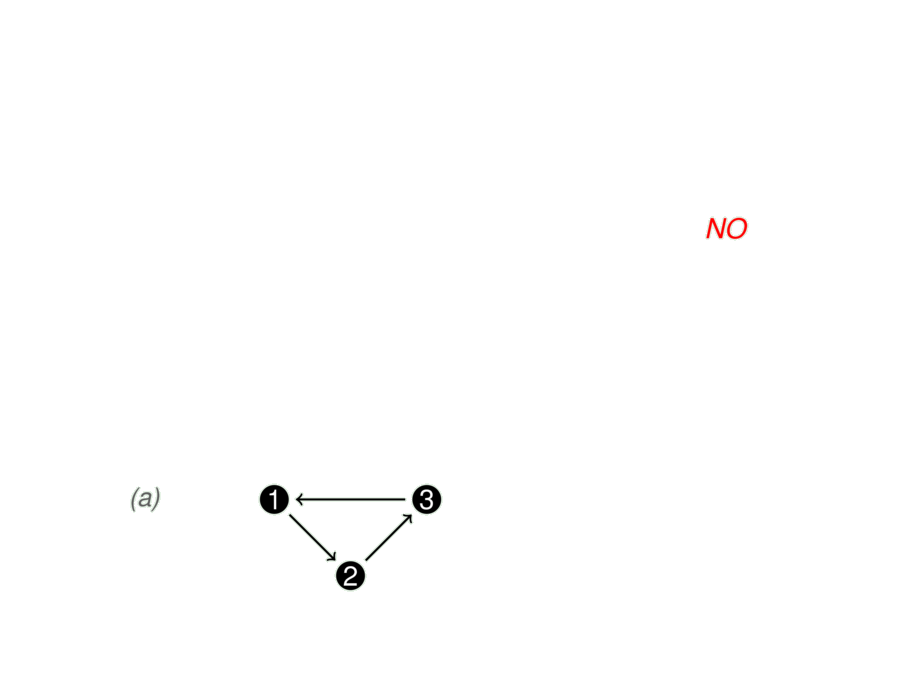
      \text{\hint{(a)}}\quad\quad \myall{x}{\myex{y}{R(x,y)}} \;\;&\models\;\; \myex{x}{\myall{y}{R(x,y)}} \mpause[2]{\quad\quad \alert{NO}} \\
      \text{\hint{(b)}}\quad\quad \myall{x}{\myex{y}{R(x,y)}} \;\;&\models\;\; \myex{y}{\myall{x}{R(x,y)}} \mpause{\quad\quad \alert{NO}} \\
      \text{\hint{(c)}}\quad\quad \myex{y}{\myall{x}{R(x,y)}} \;\;&\models\;\;  \myall{x}{\myex{y}{R(x,y)}} \mpause{\quad\quad \alert{YES}} \\
      \text{\hint{(d)}}\quad\quad \myex{y}{\myall{x}{R(x,y)}} \;\;&\models\;\;  \myall{y}{\myex{x}{R(x,y)}} \mpause{\quad\quad \alert{NO}}
    \end{talign}
    \pause
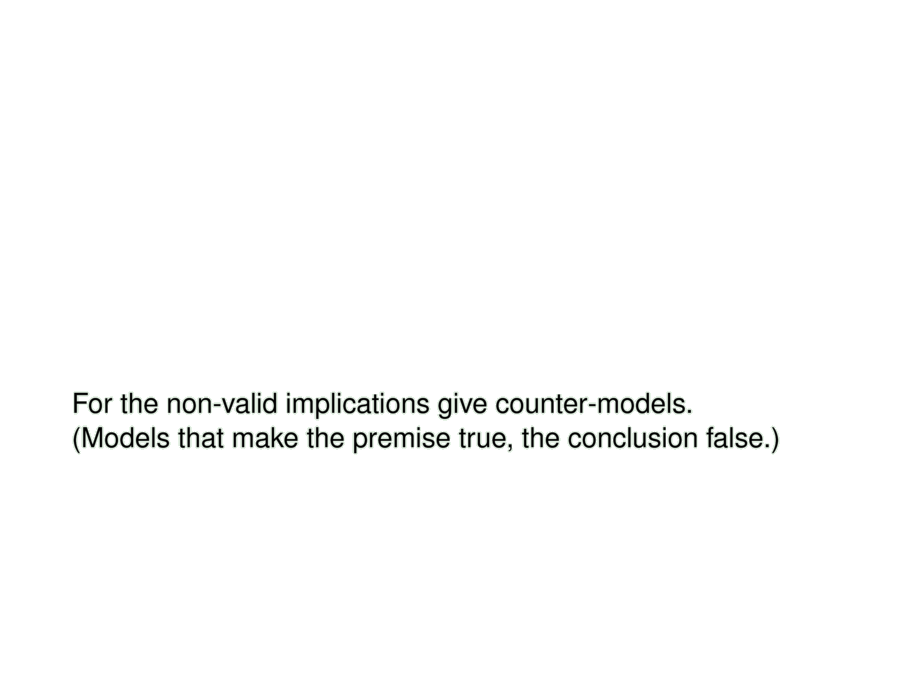
    For the non-valid implications give counter-models.\\
    (Models that make the premise true, the conclusion false.)
    \begin{center}
      \begin{tikzpicture}[node distance=15mm,
        dot/.style={minimum size=4mm, circle, draw=none, fill=black, inner sep=0, outer sep=1mm, text=white}]
        \mpause[1]{
        \begin{scope}
        \node at (-1.5,0) {\hint{(a)\mpause{, (b)}}};
        \node [dot] (1) {1};
        \node [dot,below right of=1] (2) {2};
        \node [dot,above right of=2] (3) {3};
        \begin{scope}[->,thick]
        \draw (1) -- (2);
        \draw (2) -- (3);
        \draw (3) -- (1);
        \end{scope}
        \end{scope}
        }

        \mpause{}
        \mpause{
        \begin{scope}[xshift=50mm]
        \node at (-1,0) {\hint{(d)}};
        \node [dot] (1) {1};
        \node [dot,below right of=1] (2) {2};
        \node [dot,above right of=2] (3) {3};
        \begin{scope}[->,thick]
        \draw (1) -- (2);
        \draw (3) -- (2);
        \draw (2) to[out=-45,in=-45-90,looseness=5] (2);
        \end{scope}
        \end{scope}
        }
      \end{tikzpicture}
    \end{center}\vspace{-2ex}
    \pause\pause\pause\pause\pause
    Thus only (c) is a valid semantic implication!
  \end{exampleblock}
\end{frame}