


64/212
\begin{frame}
  \frametitle{Checking Conflict-Serializability}

  \begin{block}{}
    If the precedence graph has no cycles,
    then an equivalent serial schedule is obtained by a \emph{topological sort} of the precedence graph.
  \end{block}
  \pause

  \begin{exampleblock}{}
    {\def\scheduleWidth{1cm}
    \begin{tcenter}
      \begin{tikzpicture}[node distance=15mm]
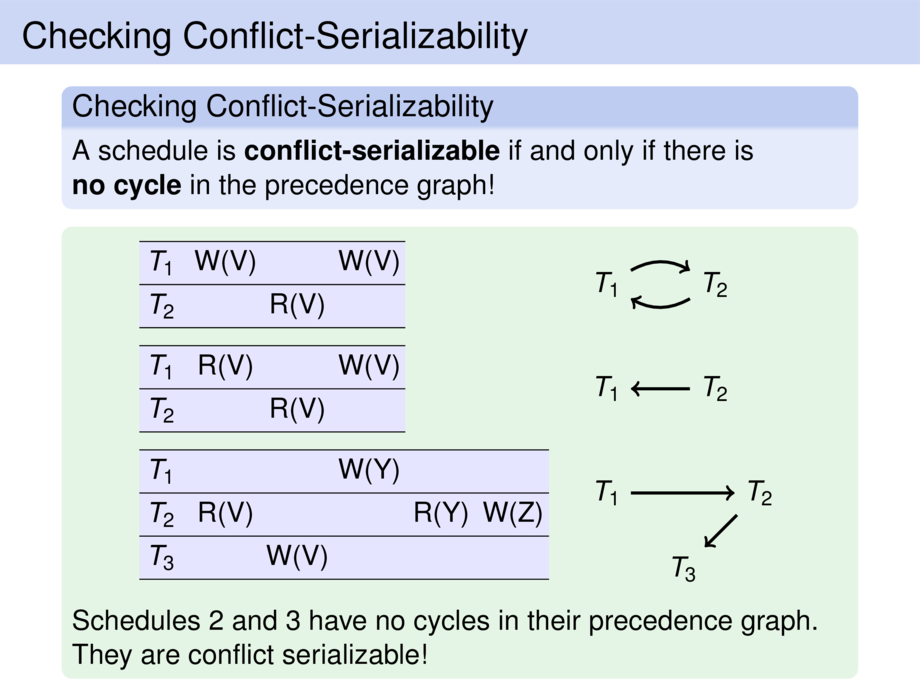
        \schedule{}{3}{2rV|1wY|3wV|2rY|2wZ}

        \node (t1) at (6.5cm,-\scheduleHeight) {$T_1$};
        \node (t3) [below right of=t1] {$T_3$};
        \node (t2) [above right of=t3] {$T_2$};
        \draw [very thick,->] (t1) -- (t2);
        \draw [very thick,->] (t2) -- (t3);
      \end{tikzpicture}
    \end{tcenter}
    }\vspace{-2ex}
    \begin{itemize}
    \pause
      \item There is an edge from $T_1$ to $T_2$ thus $T_1$ must be before $T_2$.
    \pause
      \item There is an edge from $T_2$ to $T_3$ thus $T_2$ must be before $T_3$.
    \end{itemize}
    \pause

    The sorting which fulfils these criteria is: $T_1,T_2,T_3$.
    \pause\smallskip

    This yields the equivalent serial schedule:
    {\def\scheduleWidth{1cm}
    \begin{tcenter}
      \begin{tikzpicture}
        \schedule{}{3}{1wY|2rV|2rY|2wZ|3wV}
      \end{tikzpicture}
    \end{tcenter}
    }
  \end{exampleblock}
\end{frame}