


290/291
\begin{frame}
  \frametitle{Other Constraints}

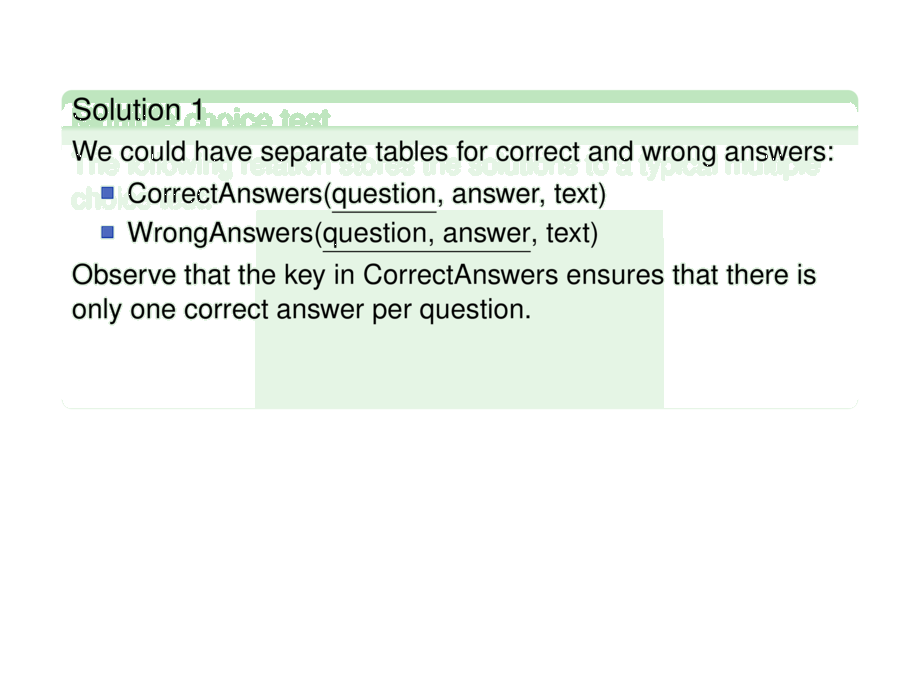
  \begin{exampleblock}{Solution 1}
    We could have separate tables for correct and wrong answers:
    \begin{itemize}
      \item CorrectAnswers(\key{question}, answer, text)
      \item WrongAnswers(\key{question, answer}, text)
    \end{itemize}
    Observe that the key in CorrectAnswers ensures that there is only one correct answer per question.
    \pause\smallskip

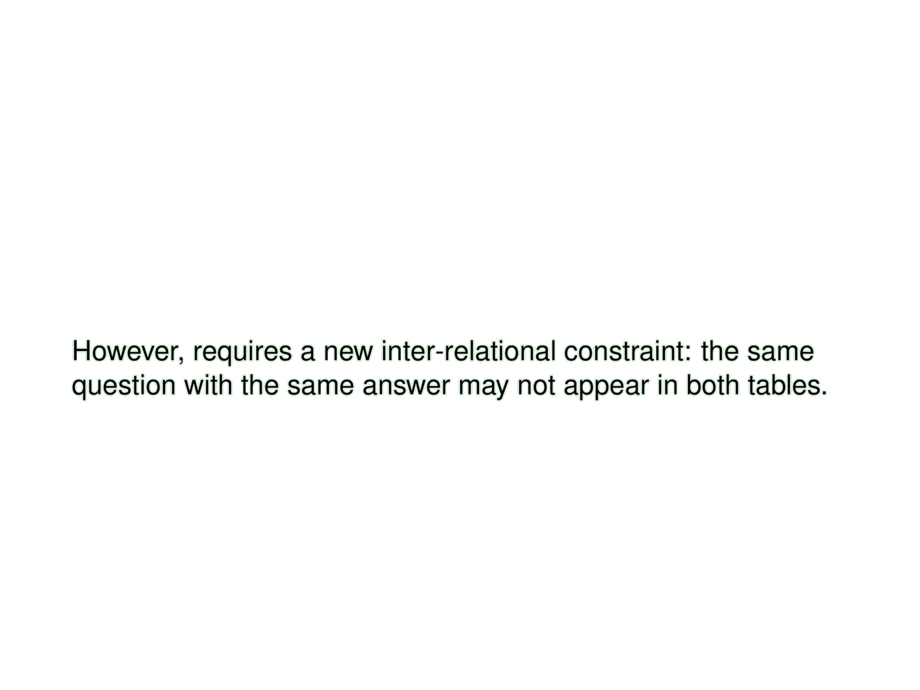
    However, requires a new inter-relational constraint:
    the same question with the same answer may not appear in both tables.
  \end{exampleblock}
  \pause

  \begin{exampleblock}{Solution 2}
    We could have separate tables for correct and wrong answers:
    \begin{itemize}
      \item Questions((\key{question}, correctAnswer) $\to$ Answers, text)
      \item Answers(\key{question} $\to$ Questions, \key{\vphantom{q}answer}, text)
    \end{itemize}
    Here the correct answer is indicated via a foreign key in Questions referencing the Answers table.
  \end{exampleblock}
\end{frame}