


255/291
\begin{frame}
  \frametitle{Multivalued Dependencies}

  \begin{goal}{}
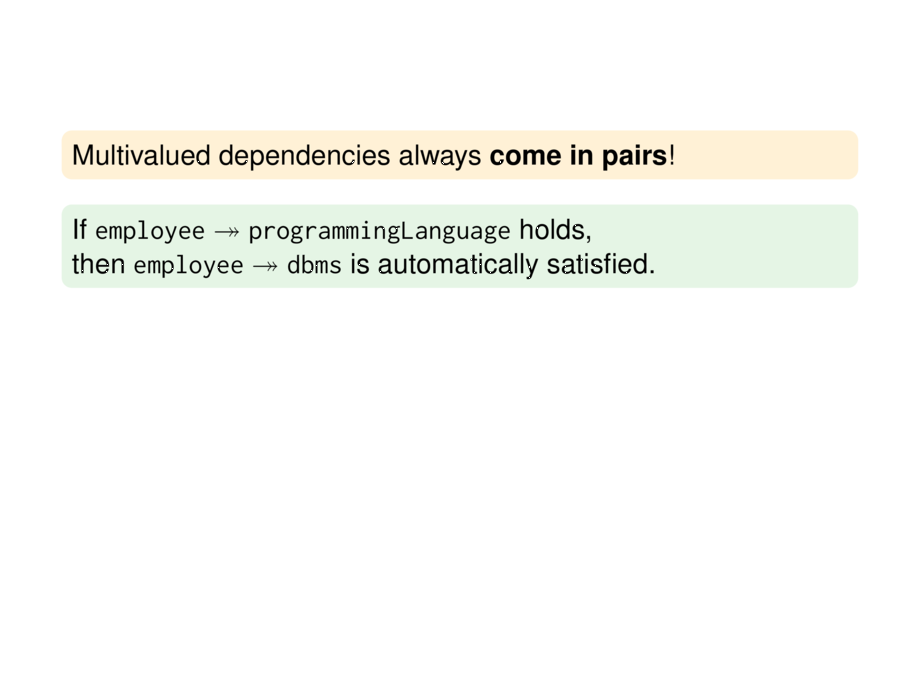
    Multivalued dependencies always \emph{come in pairs}!
  \end{goal}

  \begin{exampleblock}{}
    If $\sql{employee} \mvd \sql{programmingLanguage}$ holds,  \\
    then $\sql{employee} \mvd \sql{dbms}$ is automatically satisfied.
  \end{exampleblock}
  \bigskip
  \pause

  More general:
  \begin{block}{}
    For a relation $R(A_1, \dots, A_n, B_1, \dots, B_m, C_1, \dots, C_k)$,\\
    the following multivalued dependencies are equivalent
    \begin{itemize}
      \item $A_1, \dots, A_n \mvd B_1, \dots, B_m$
      \item $A_1, \dots, A_n \mvd C_1, \dots, C_k$
    \end{itemize}
  \end{block}
  \remark{%
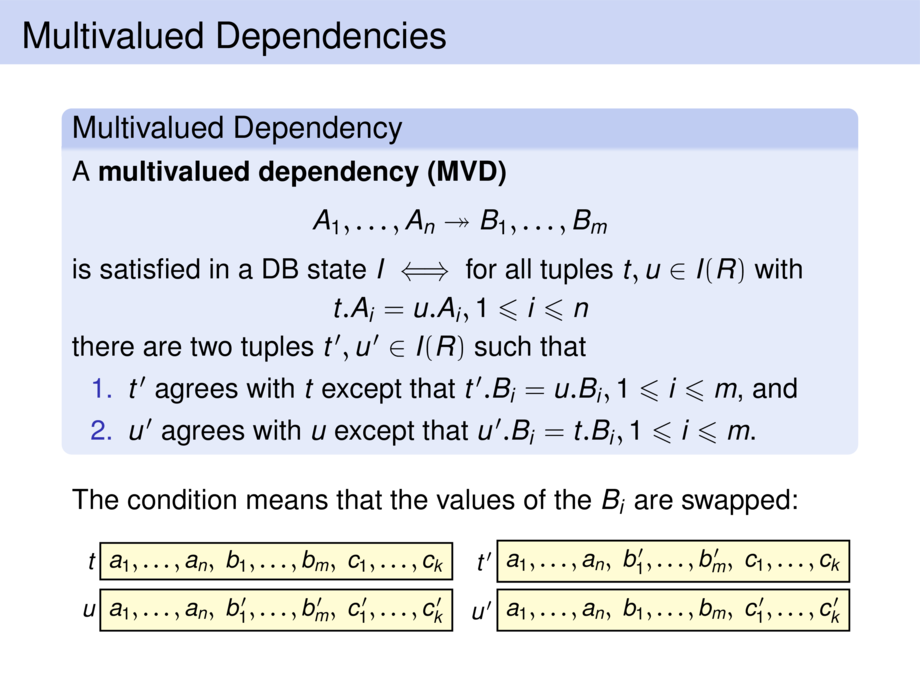
    Swapping the $B_j$ values
    in two tuples is the same as swapping the values for all other
    columns (the $A_i$ values are identical, swapping them has no effect).
  }
\end{frame}