


69/98
\begin{frame}
  \frametitle{IS-A, `Inheritance'}

  \begin{minipage}{.4\textwidth}
  \begin{center}
    \scalebox{.8}{\hspace*{-3ex}
    \begin{tikzpicture}[every edge/.style={link},d/.style={node distance=1cm}]
      \node[entity] (A) {person};
        \node[attribute,above of=A,d,xshift=-1.2cm] (name) {name} edge (person);
        \node[attribute,above of=A,d,xshift=1.2cm] (address) {address} edge (person);

      \node[entity,at=(A),shift={(-1.5cm,-2.4cm)}] (B) {employee};
        \node[attribute,above of=B,node distance=1.2cm,xshift=-.2cm] (salary) {salary} edge (employee);
      \node[entity,at=(A),shift={(1.5cm,-2.4cm)}] (C) {customer};
      \node[isa,at=(person),shift={(0cm,-0.8cm)}] {ISA} edge (A) edge (B) edge (C);
    \end{tikzpicture}
    }
  \end{center}
  \end{minipage}
  \begin{minipage}{.59\textwidth}
    \begin{goal}{}
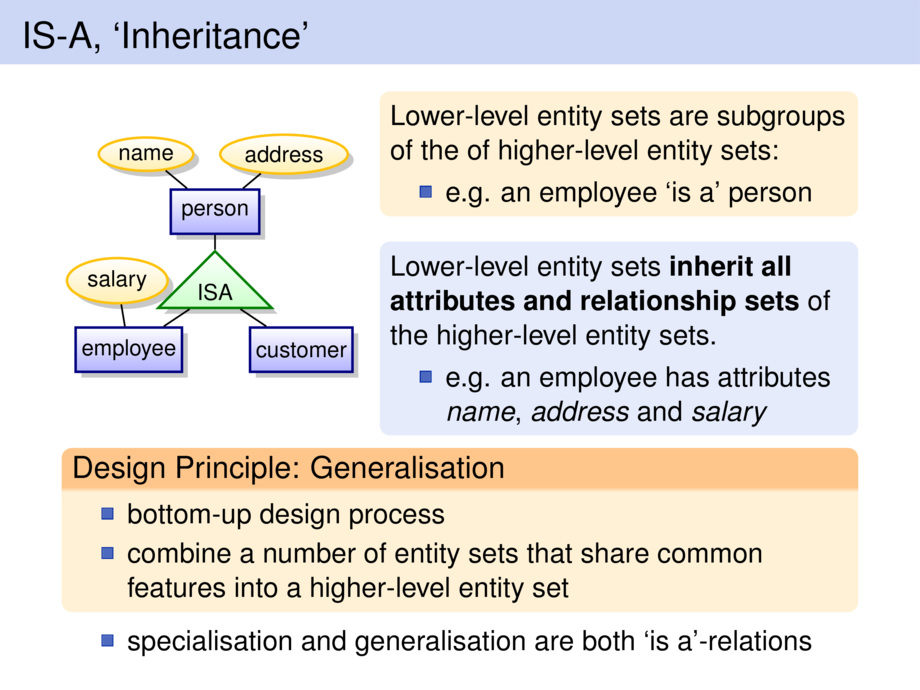
    Lower-level entity sets are subgroups of the of higher-level entity sets:
    \begin{itemize}
      \item e.g. an employee `is a' person
    \end{itemize}
    \end{goal}
    \pause
    \begin{block}{}
      Lower-level entity sets \emph{inherit all attributes and relationship sets}
      of the higher-level entity sets.
      \begin{itemize}
        \item e.g. an employee has attributes \textit{name}, \textit{address} and \textit{salary}
      \end{itemize}
    \end{block}
  \end{minipage}
  \pause

  \alt<-3>{
  \begin{goal}{Design Principle: Specialisation}
    \begin{itemize}
      \item top-down design process
      \item identify subgroups within an entity set
      \item these subgroups become lower-level entity sets which
            may have attributes or participate in relationship sets
            that do not apply to the higher-level entity sets
    \end{itemize}
  \end{goal}
  }{
  \begin{goal}{Design Principle: Generalisation}
    \begin{itemize}
      \item bottom-up design process
      \item combine a number of entity sets that share common features
            into a higher-level entity set
    \end{itemize}
  \end{goal}
  \begin{itemize}
    \item specialisation and generalisation are both `is a'-relations
  \end{itemize}
  }
  \pause
  \vspace{10cm}
\end{frame}