


19/77
\begin{frame}
  \frametitle{Database States}

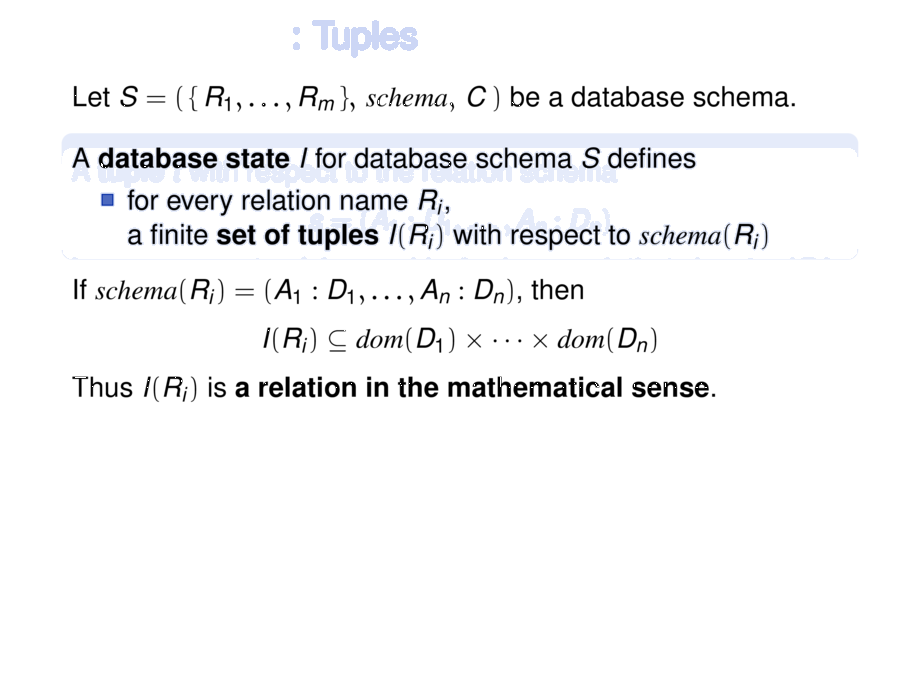
  Let $S = (\, \{\,R_1, \dots, R_m\,\},\, \var{schema},\, C \,)$ be a database schema.
  \begin{block}{}
    A \textbf{database state} $I$ for database schema $S$ defines
    \begin{itemize}
      \item
        for every relation name $R_i$, \\
        a finite \textbf{set of tuples} $I(R_i)$ with respect to $\schema{R_i}$
    \end{itemize}
  \end{block}
  If $\schema{R_i} = (A_{1}:D_{1},\dots,A_{n}:D_{n})$, then
  \begin{talign}
    I(R_i) \subseteq \dom{D_{1}} \times \cdots \times \dom{D_{n}}
  \end{talign}
  Thus $I(R_i)$ is \emph{a relation in the mathematical sense}.
  \pause

  \begin{exampleblock}{}
    \emph{Databases state = set of tables conforming to the schema:}
    \begin{center}\vspace{-2.5ex}
      \scalebox{.5}{{\ttfamily\tableStudents\tableExercises}}
      \vspace{-1.5ex}
    \end{center}
    \emph{Except:}
    \begin{itemize}
      \item there is \emph{no order} on the tuples (rows), and
      \item tables contain \emph{no duplicate} tuples.
    \end{itemize}
  \end{exampleblock}
\end{frame}