


74/98
\begin{frame}
  \frametitle{The Area below a Curve}

  \begin{block}{}
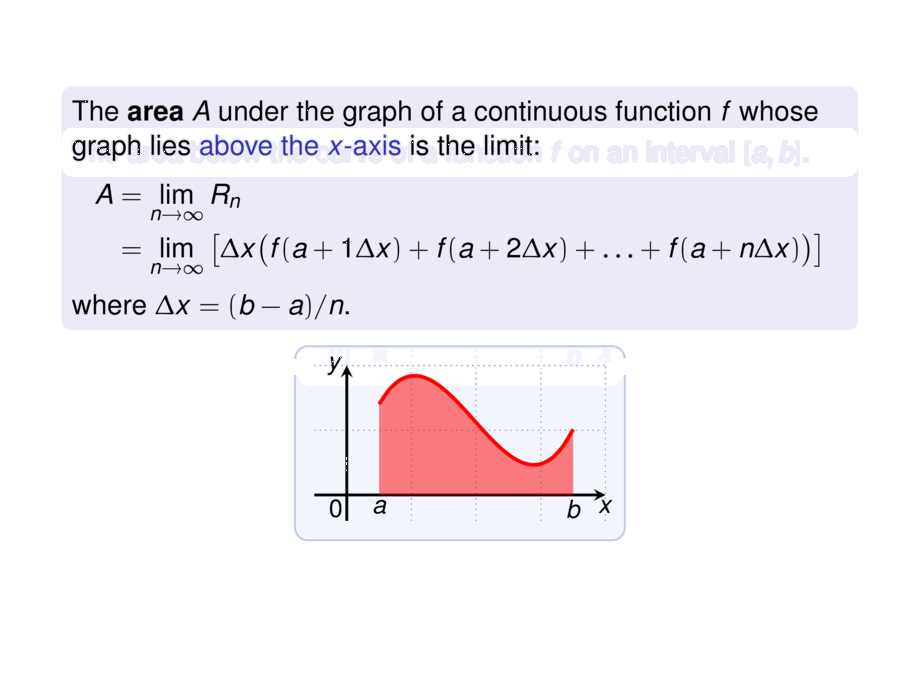
    The \emph{area} $A$ under the graph of a continuous function $f$
    whose graph lies \structure{above the $x$-axis} is the limit:
%     is the limit of the sum of the areas of the approximating rectangles:
    \begin{talign}
      A &= \lim_{n\to \infty} R_n \\
      &= \lim_{n\to \infty} \left[ \Delta x\big(f(a + 1\Delta x) + f(a + 2\Delta x) + \ldots + f(a + n\Delta x)\big) \right]
    \end{talign}
    where $\Delta x = (b-a)/n$.
  \end{block}
  \begin{center}
  \scalebox{.9}{
  \begin{tikzpicture}[default]
    \def\mfun{(4*(\x+\mfunshift) - 2.6*(\x+\mfunshift)^2 + .44*(\x+\mfunshift)^3)}

    {\def\diaborderx{.3cm}
    \def\diabordery{.3cm}
    \diagram[1]{-.5}{4}{-.4}{2}{1}}
    \diagramannotatez
    \def\mfunshift{0}
    \begin{scope}[ultra thick]
      \draw[cred] plot[smooth,domain=.5:3.5,samples=20] (\x,{\mfun});
      \draw[draw=none,fill=cred,opacity=.5] (.5,0) -- plot[smooth,domain=.5:3.5,samples=20] (\x,{\mfun}) -- (3.5,0) -- (.5,0) -- cycle;
      \node[anchor=north] at (.5,0) {$a$};
      \node[anchor=north] at (3.5,0) {$b$};
    \end{scope}
  \end{tikzpicture}
  }
  \end{center}\vspace{-1ex}
  \pause

  \begin{block}{}
     For continuous $f$ this limit always exists, and is the same as
    \begin{talign}
      \lim_{n\to \infty} L_n = \lim_{n\to \infty} \left[ \Delta x\big(f(a + 0\Delta x) + \ldots + f(a + (n-1)\Delta x)\big) \right]
    \end{talign}
  \end{block}

  \vspace{10cm}
\end{frame}