


133/142
\begin{frame}
  \frametitle{Linear Approximation and Differentials}

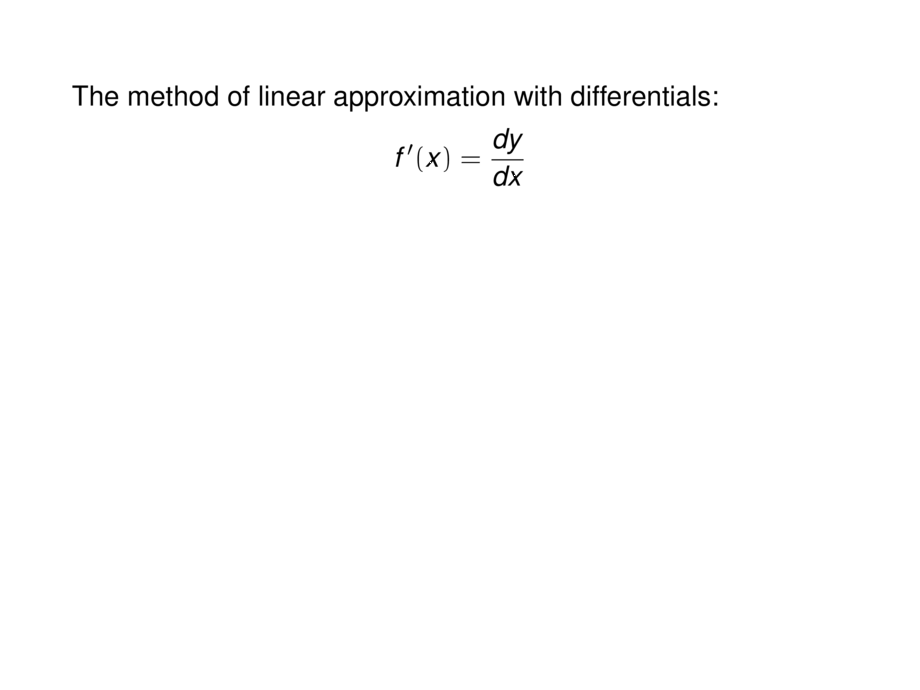
  The method of linear approximation with differentials:
  \begin{talign}
    f'(x) = \frac{dy}{dx}
  \end{talign}
  \pause
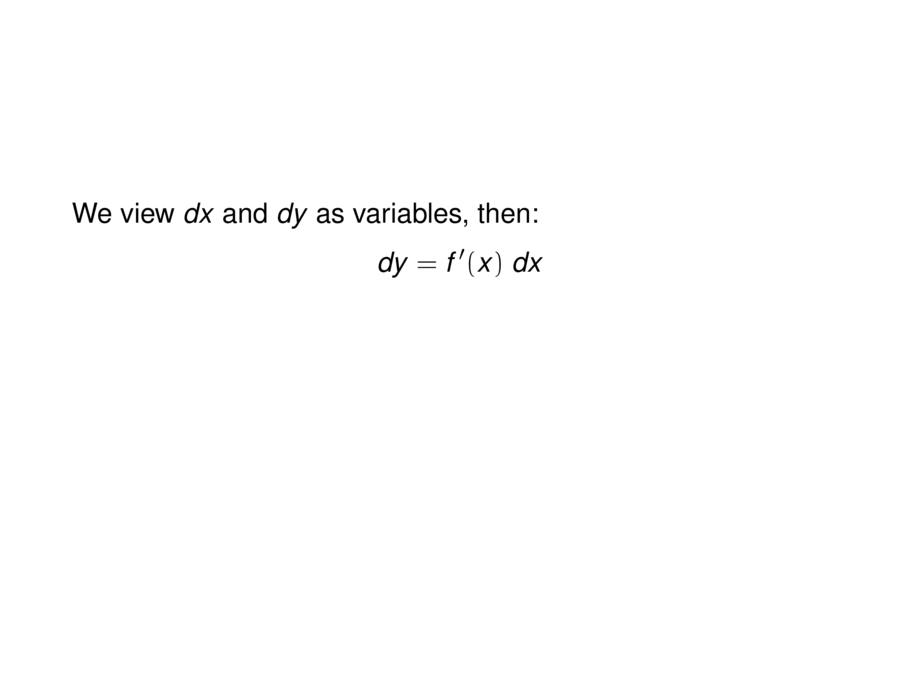
  We view $dx$ and $dy$ as variables, then:
  \begin{talign}
    dy = f'(x)\; dx
  \end{talign}
  \pause
  So $dy$ depends on the value of $x$ and $dx$.
  \medskip\pause

  \begin{minipage}{.43\textwidth}
  \begin{center}
  \scalebox{.8}{
  \begin{tikzpicture}[default,baseline=1cm]
    \def\diabordery{.7cm}
    \diagram{-0.5}{4}{-.5}{4}{1}
    \diagramannotatez
    \begin{scope}[ultra thick]
      \draw[cgreen,ultra thick] plot[smooth,domain=-.5:3,samples=200] function{(x-1)**2};
      \tangent{1.5cm}{2.1cm}{pow(\x-1,2)}{1.5}
      \node[include=cred] (a) at (1.5,.25) {};
      \draw[gray] (a) -- node [at end,below,black] {$x$} +(0,-.5);
      \draw[gray] (3,4) -- (3,-.25);
      \draw[gray,decorate,decoration={brace,amplitude=5pt,mirror,raise=2pt}] (1.5,-.5) -- node[below,black,yshift=-2mm] {$\Delta x = dx$} (3,-.5);
      \draw[cred,decorate,decoration={brace,amplitude=5pt,mirror,raise=10pt}] (3,.25) -- node[right,black,xshift=6mm] {$dy$} (3,1.75);
      \draw[cgreen,decorate,decoration={brace,amplitude=5pt,mirror,raise=4pt}] (3,.25) -- node[right,black,xshift=4mm] {$\Delta y$} (3,4);
    \end{scope}
  \end{tikzpicture}
  }
  \end{center}
  \end{minipage}
  \begin{minipage}{.56\textwidth}
    \begin{itemize}
    \pause
      \item $x =$ point of linearization
    \pause\smallskip
      \item $\Delta x = dx$ is the distance from $x$\\
    \pause\smallskip
      \item $dy =$ change of $y$ of tangent
    \pause\smallskip
      \item $\Delta y = $ change of $y$ of curve~$f$
    \end{itemize}
    \pause
    As formulas:
    \begin{itemize}
    \pause
      \item $dy = f'(x)\; dx$
    \pause
      \item $\Delta y = f(x +\Delta x) - f(x)$
    \end{itemize}
  \end{minipage}
\end{frame}