


14/142
\begin{frame}
  \frametitle{Linear Approximation and Differentials}

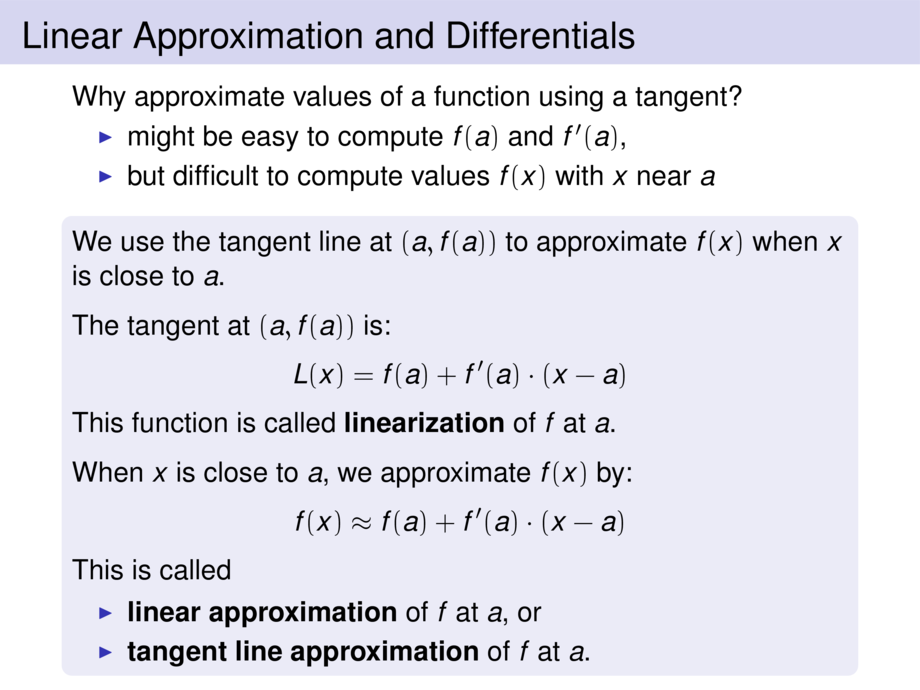
  Why approximate values of a function using a tangent?
  \begin{itemize}
  \pause
    \item might be easy to compute $f(a)$ and $f'(a)$,
  \pause
    \item but difficult to compute values $f(x)$ with $x$ near $a$
  \end{itemize}
  \pause

  \begin{block}{}
    We use the tangent line at $(a,f(a))$ to approximate $f(x)$ when $x$ is close to $a$.
    \pause\medskip

    The tangent at $(a,f(a))$ is:
    \begin{talign}
      L(x) = f(a) + f'(a)\cdot (x-a)
    \end{talign}
    \pause
    This function is called \emph{linearization} of $f$ at $a$.
    \pause\medskip

    When $x$ is close to $a$, we approximate $f(x)$ by:
    \begin{talign}
      f(x) \approx f(a) + f'(a)\cdot (x-a)
    \end{talign}
    \pause
    This is called
    \begin{itemize}
    \pause
      \item \emph{linear approximation} of $f$ at $a$, or
    \pause
      \item \emph{tangent line approximation} of $f$ at $a$.
    \end{itemize}
  \end{block}
\end{frame}