


18/115
\begin{frame}
  \frametitle{Precise Definition of Limits: Example}

  \begin{exampleblock}{}
    \vspace{-1ex}
    \begin{talign}
      f(x) = \begin{cases}
        2x - 1 &\text{for $x \ne 3$}\\
        6 &\text{for $x = 3$}
      \end{cases}
    \end{talign}
    \pause
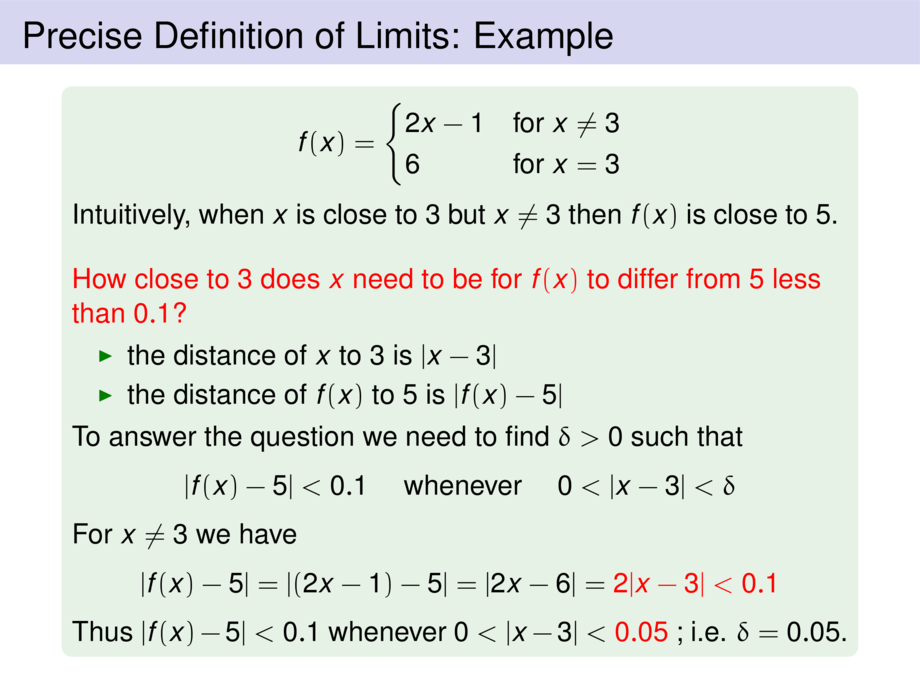
    Intuitively, when $x$ is close to $3$ but $x\ne 3$ then $f(x)$ is close to $5$.
    \pause\bigskip

    \alert{
    How close to $3$ does $x$ need to be for $f(x)$ to differ from $5$ less than $0.1$?
    }
    \begin{itemize}
    \pause
      \item the distance of $x$ to $3$ is $|x-3|$
    \pause
      \item the distance of $f(x)$ to $5$ is $|f(x)-5|$
    \end{itemize}
    \pause
    To answer the question we need to find $\delta > 0$ such that
    \begin{talign}
      |f(x) - 5| < 0.1 \quad\text{ whenever }\quad 0 < |x-3| < \delta
    \end{talign}
    \pause
    For $x \ne 3$ we have
    \begin{talign}
      |f(x) - 5| \mpause[1]{ = |(2x-1)-5|}
      \mpause[2]{ = |2x-6|}
      \mpause[3]{ = \alert<11->{2|x-3|}}
      \mpause[4]{ \alert{< 0.1}}
    \end{talign}
    \pause\pause\pause\pause\pause
    Thus $|f(x) - 5| < 0.1$ whenever $0 < |x-3| < \alert{\alt<-11>{?}{0.05}}$
    \pause;
    i.e. $\delta = 0.05$.
  \end{exampleblock}
  \vspace{10cm}
\end{frame}