


72/154
\begin{frame}
  \frametitle{Limit: Examples}

  \begin{exampleblock}{}
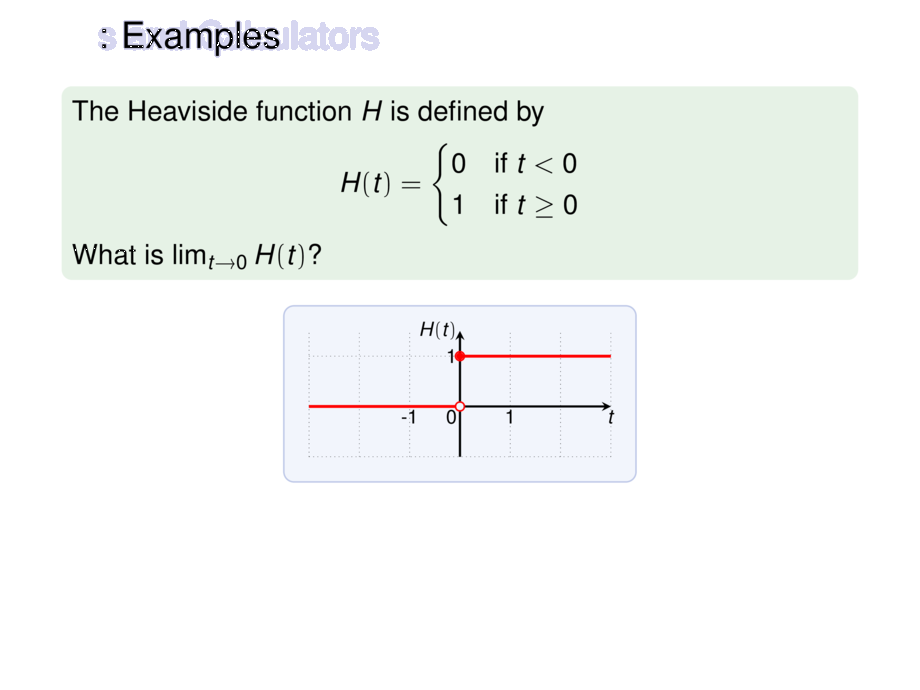
    The Heaviside function $H$ is defined by
    \begin{talign}
      H(t) = \begin{cases}
        0 & \text{if $t < 0$}\\
        1 & \text{if $t \ge 0$}\\
      \end{cases}
    \end{talign}
    What is $\lim_{t\to 0} H(t)$?
  \end{exampleblock}
  \smallskip

  \begin{center}
    {\def\diax{t}\def\diay{H(t)}
    \scalebox{.7}{
    \begin{tikzpicture}[default]
      \diagram{-3}{3}{-1}{1.5}{1}
      \diagramannotatez
      \diagramannotatex{-1,1}
      \diagramannotatey{1}
      \draw[cred,ultra thick] plot[smooth,domain=-3:0,samples=20] function{0};
      \draw[cred,ultra thick] plot[smooth,domain=0:3,samples=20] function{1};

      \def\x{0}
      \def\y{{1}}
      \node[include={cred}] at (\x,\y) {};
      \node[exclude={cred}] at (0,0) {};
    \end{tikzpicture}
    }}
  \end{center}\vspace{-1ex}

  \begin{itemize}
  \pause
    \item As $t$ approaches $0$ from the left, $H(t)$ approaches $0$.
  \pause
    \item As $t$ approaches $0$ from the right, $H(t)$ approaches $1$.
  \end{itemize}
  \medskip\pause

  Thus there is not single number that $H(t)$ approaches.\vspace{-.5ex}
  \begin{exampleblock}{}
    The limit $\lim_{t\to 0} H(t)$ does not exist.
  \end{exampleblock}

  \vspace{10cm}
\end{frame}