


41/353
\begin{frame}
  \frametitle{Power Functions: Special Cases}

  \begin{exampleblock}{}
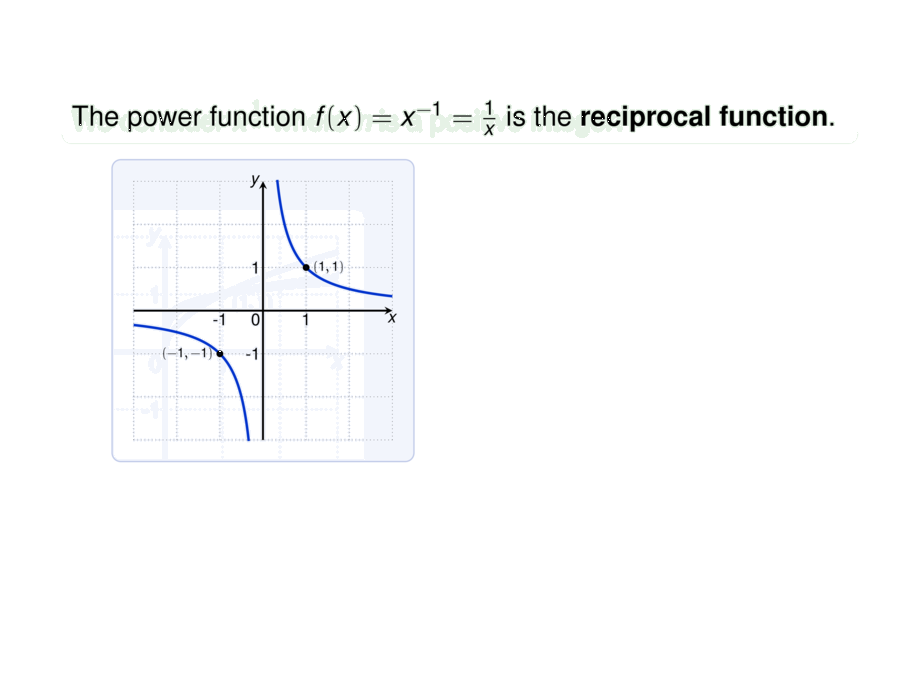
  The power function $f(x) = x^{-1} = \frac{1}{x}$ is the \emph{reciprocal function}.
  \end{exampleblock}

  \begin{center}
  \begin{minipage}{.49\textwidth}
  \scalebox{.6}{
  \begin{tikzpicture}[default,baseline=1cm]
    \diagram{-3}{3}{-3}{3}{1}
    \diagramannotatez
    \diagramannotatex{-1,1}
    \diagramannotatey{-1,1}
    \begin{scope}[ultra thick]
    \draw[cblue] plot[smooth,domain=0.33:3,samples=100] (\x,{1/\x});
    \draw[cblue] plot[smooth,domain=-3:-0.33,samples=100] (\x,{1/\x});

    \node (a) [include=black,minimum size=1mm] at (1,1) {};
    \node[r=(a)] {$(1,1)$};
    \node (b) [include=black,minimum size=1mm] at (-1,-1) {};
    \node[l=(b)] {$(-1,-1)$};
    \end{scope}
  \end{tikzpicture}
  }
  \end{minipage}
  \onslide<3->{
  \begin{minipage}{.40\textwidth}
  \scalebox{.6}{
  \begin{tikzpicture}[default,baseline=1cm]
    {\def\diax{P}
    \def\diay{V}
    \diagram{-1}{5}{-1}{5}{1}}
    \diagramannotatez
    \begin{scope}[ultra thick]
    \draw[cblue] plot[smooth,domain=0.4:5,samples=100] (\x,{2/\x});
    \end{scope}
  \end{tikzpicture}
  }
  \end{minipage}
  }
  \end{center}

  \pause\smallskip

  \begin{exampleblock}{}
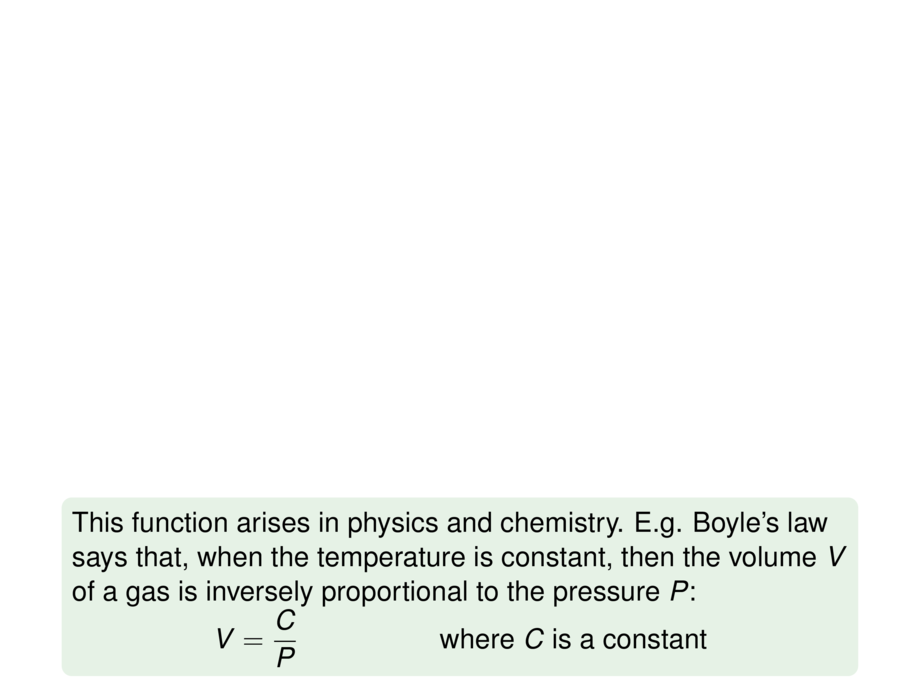
    This function arises in physics and chemistry. E.g. Boyle's law
    says that, when the temperature is constant, then the volume $V$ of a gas
    is inversely proportional to the pressure $P$:
    \begin{malign}
      V = \frac{C}{P} &&\text{where $C$ is a constant}
    \end{malign}
  \end{exampleblock}
  \vspace{10cm}
\end{frame}