


21/353
\begin{frame}
  \frametitle{Polynomials}

  \begin{block}{}
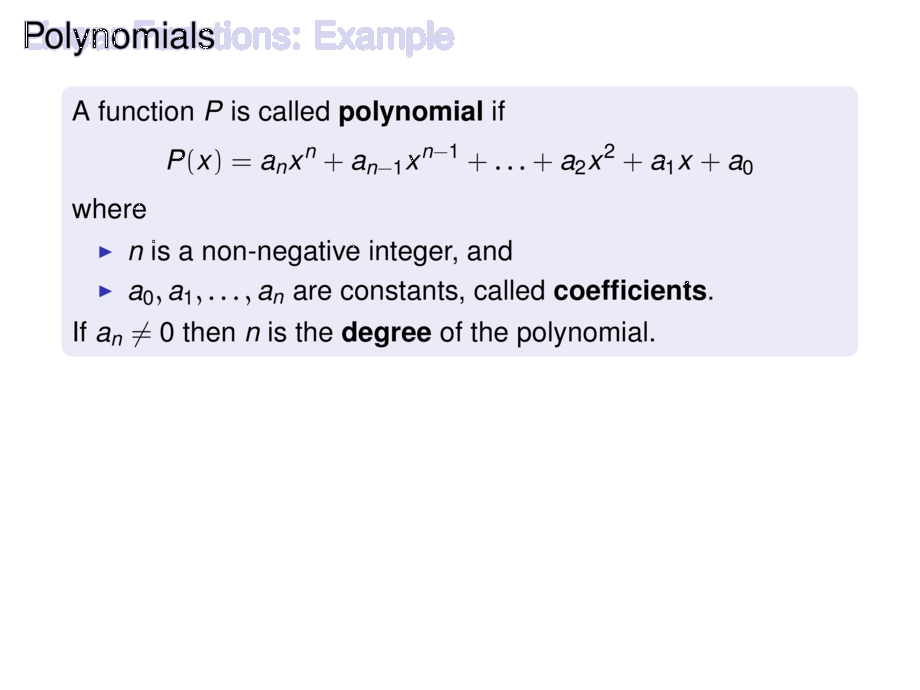
    A function $P$ is called \emph{polynomial} if
    \begin{talign}
      P(x) = a_n x^n + a_{n-1} x^{n-1} + \ldots + a_2 x^2 + a_1 x + a_0
    \end{talign}
    where
    \begin{itemize}
      \item $n$ is a non-negative integer, and
      \item $a_0,a_1,\ldots,a_n$ are constants, called \emph{coefficients}.
    \end{itemize}
    If $a_n \ne 0$ then $n$ is the \emph{degree} of the polynomial.
  \end{block}

  \pause\medskip
%   \begin{exampleblock}{}
%     $P(x) = 2x^6 - x^4 + \frac{3}{5}x + \sqrt{2}$ is a polynomial of degree $6$.
%   \end{exampleblock}
%   \pause\medskip

  \begin{minipage}{.3\textwidth}
  \scalebox{.6}{
  \begin{tikzpicture}[default]
    \diagram{-2}{2}{-2}{3}{1}
    \diagramannotatez
    \diagramannotatex{-1,1}
    \diagramannotatey{-1,1}
    \draw[cblue,ultra thick] plot[smooth,domain=-1.67:1.53,samples=20] (\x,{pow(\x,3)-\x+1});
  \end{tikzpicture}
  }
  \centerline{{\small $x^3-x+1$}}
  \end{minipage}\quad
  \begin{minipage}{.3\textwidth}
  \scalebox{.6}{
  \begin{tikzpicture}[default,yscale=.5]
    {\def\diabordery{1cm}
    \diagram{-2}{2}{-4}{6}{1}}
    \diagramannotatez
    \diagramannotatex{-1,1}
    \diagramannotatey{-1,1} %,smooth,domain=-1.76:1.83,samples=20
    \draw[cblue,ultra thick] plot[smooth,domain=-2:2] (\x,{pow(\x,4) - 3*pow(\x,2) + \x});
  \end{tikzpicture}
  }
  \centerline{{\small $x^4 - 3x^2 + x$}}
  \end{minipage}\quad
  \begin{minipage}{.3\textwidth}
  \scalebox{.6}{
  \begin{tikzpicture}[default,xscale=.75,yscale=.05]
    {\def\diaborderx{.5cm/.75}
     \def\diabordery{10cm}
    \diagram[10]{-3}{3}{-40}{60}{1}}
    \diagramannotatez
    \diagramannotatex{1}
    \diagramannotatey{-20,20,40} %,smooth,domain=-1.76:1.83,samples=20
    \draw[cblue,ultra thick] plot[smooth,domain=-2.45:2.55] (\x,{3*pow(\x,5) - 25 *pow(\x,3) + 60*\x});
  \end{tikzpicture}
  }
  \centerline{\ \ {\small $3x^5 -25 x^3 + 60x$}}
  \end{minipage}
  \vspace{10cm}
\end{frame}