


37/55
\begin{frame}{Kleene Start}
  \begin{goal}{Theorem}
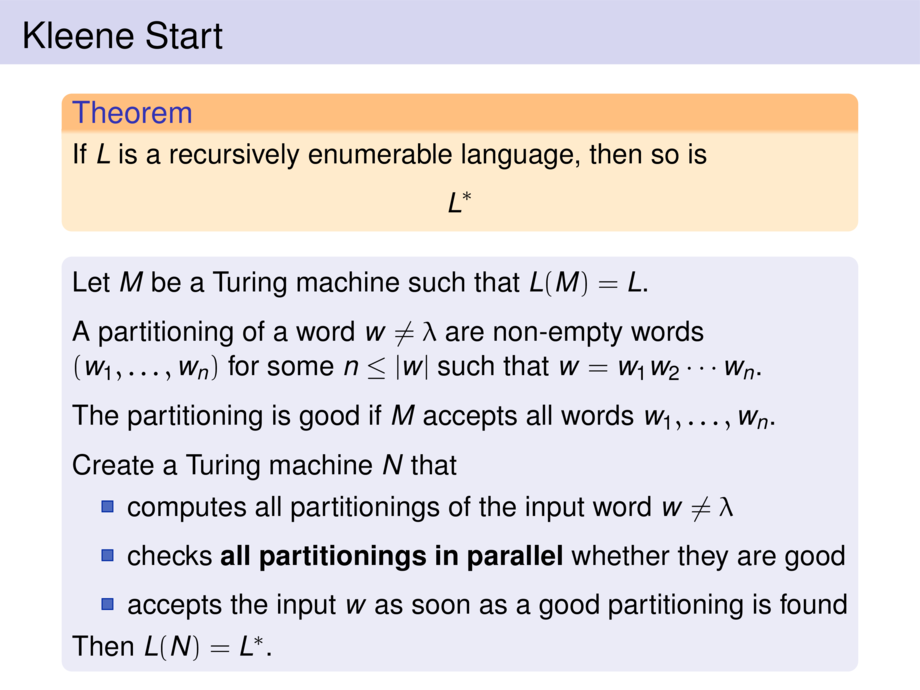
    If $L$ is a recursively enumerable language, then so is
    \begin{talign}
      L^*
    \end{talign}
  \end{goal}
  \pause
  \begin{block}{}
    Let $M$ be a Turing machine such that $L(M) = L$.
    \pause\medskip

    A partitioning of a word $w \ne \lambda$ are non-empty words $(w_1,\ldots,w_n)$ for some $n \le |w|$ such that $w = w_1 w_2 \cdots w_n$.
    \pause\medskip

    The partitioning is good if $M$ accepts all words $w_1,\ldots,w_n$.
    \pause\medskip

    Create a Turing machine $N$ that
    \begin{itemize}
      \item computes all partitionings of the input word $w \ne \lambda$
      \item checks \emph{all partitionings in parallel} whether they are good
      \item accepts the input $w$ as soon as a good partitioning is found
    \end{itemize}
    Then $L(N) = L^*$.
  \end{block}
\end{frame}